Shopify AI-Operated Catalogue: Product Data Without a Team

On this page
A Melbourne homewares founder reached 400 products after three supplier expansions in 18 months. Her AI-operated catalogue manages itself: imports run on a schedule, descriptions generate at import time, metafields populate from the supplier file. She is not doing data entry. She is reviewing exceptions and adjusting rules. That is the difference between a catalogue that consumes founder hours and one that runs in the background.
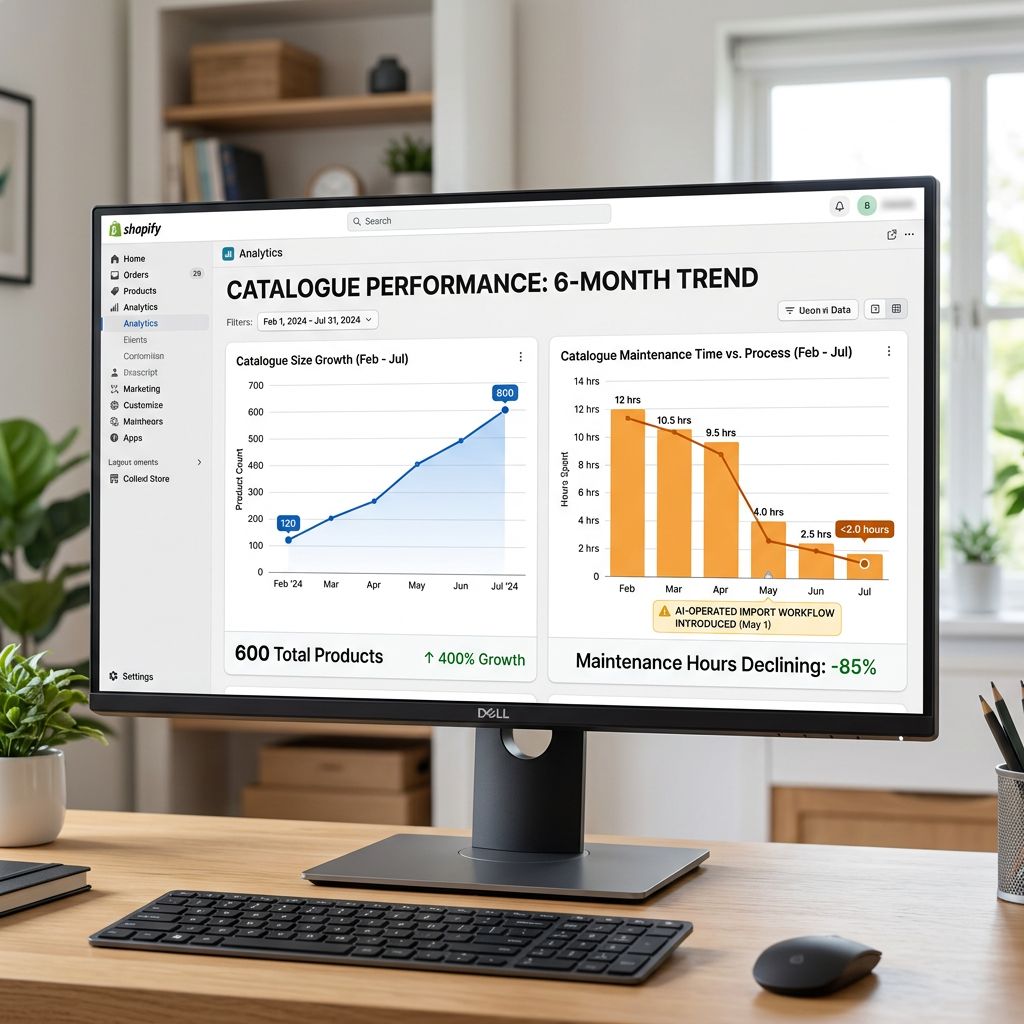
Before she reached that point, she spent 12 hours every month on catalogue maintenance alone. Updating descriptions when a supplier changed a spec. Filling metafields for new arrivals. Fixing variant data after a CSV import overwrote the wrong column. She did not have a catalogue team. She had not budgeted for one. The problem was not the volume of products; it was that every catalogue task required human time, and human time is the one resource a founder cannot scale.
What an AI-Operated Catalogue Actually Means
The phrase gets misused. An AI-operated catalogue is not one where AI makes decisions without oversight. It is one where a human sets the rules, context, and boundaries once, and then AI executes within them, at volume, without the founder's continuous involvement.
The distinction matters because both failure modes exist in practice.
Under-delegating to AI means the founder remains in the loop for every description, every metafield entry, every variant label. The tools exist to delegate this work; the founder keeps doing it manually from habit or distrust.
Over-delegating to AI means AI makes decisions it is not equipped to make: which products to feature, which supplier to prioritise, which brand voice shift a new product category needs. These are strategic calls with consequences the AI cannot evaluate.
The working model sits between them: the founder makes judgements once (the brand voice, the import mapping, the persona configuration, the review threshold), and AI executes the resulting workload.
The Three Catalogue Tasks AI Handles Best
Not every catalogue task is equally suited to AI delegation. The three that produce the highest return are description generation, metafield population, and scheduled imports.
Description generation is the clearest case. Descriptions are high-volume, style-consistent, and rule-governed: they follow the brand voice, they address the target buyer, they cover specific attributes in a specific order. A founder who has described 20 products has implicitly written the rule set for describing the next 2,000. Feeding that rule set to an AI model via a style and persona configuration turns a 12-hour monthly task into a review pass on AI output.
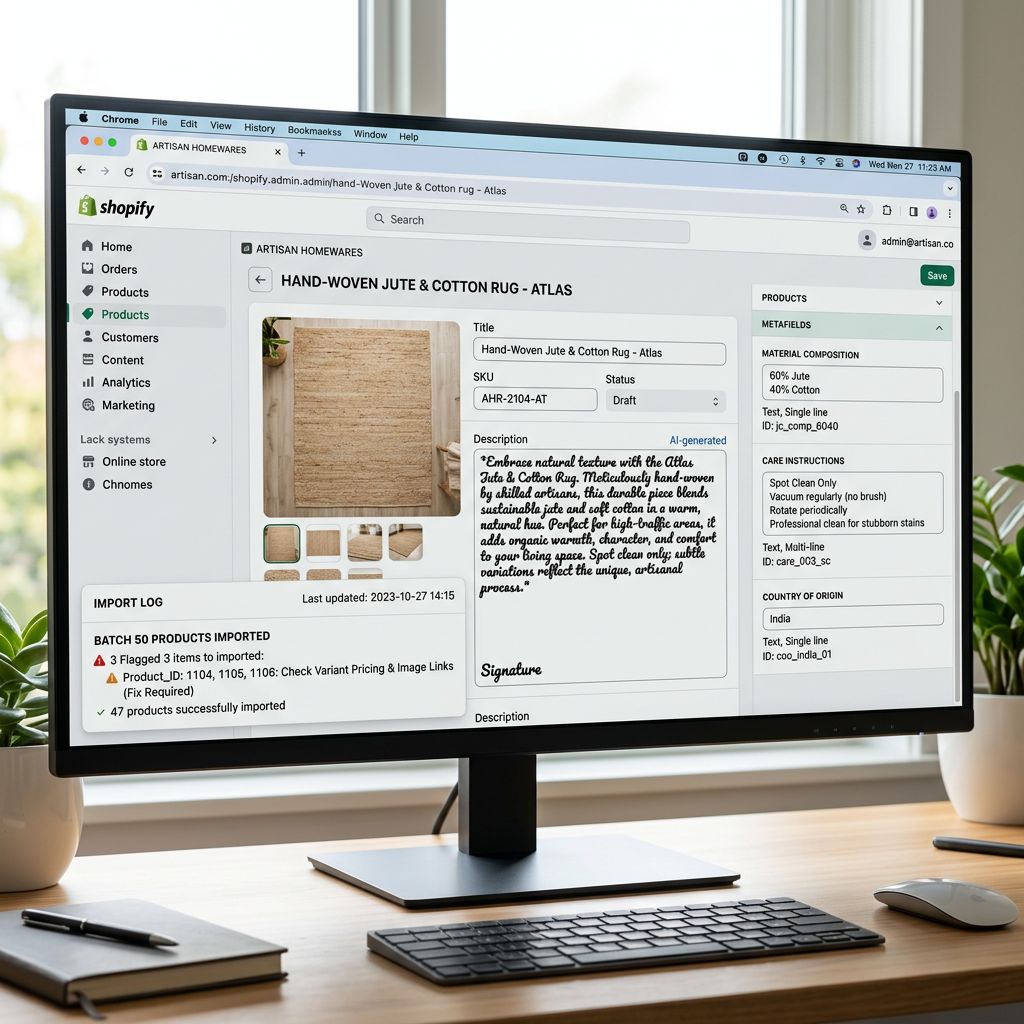
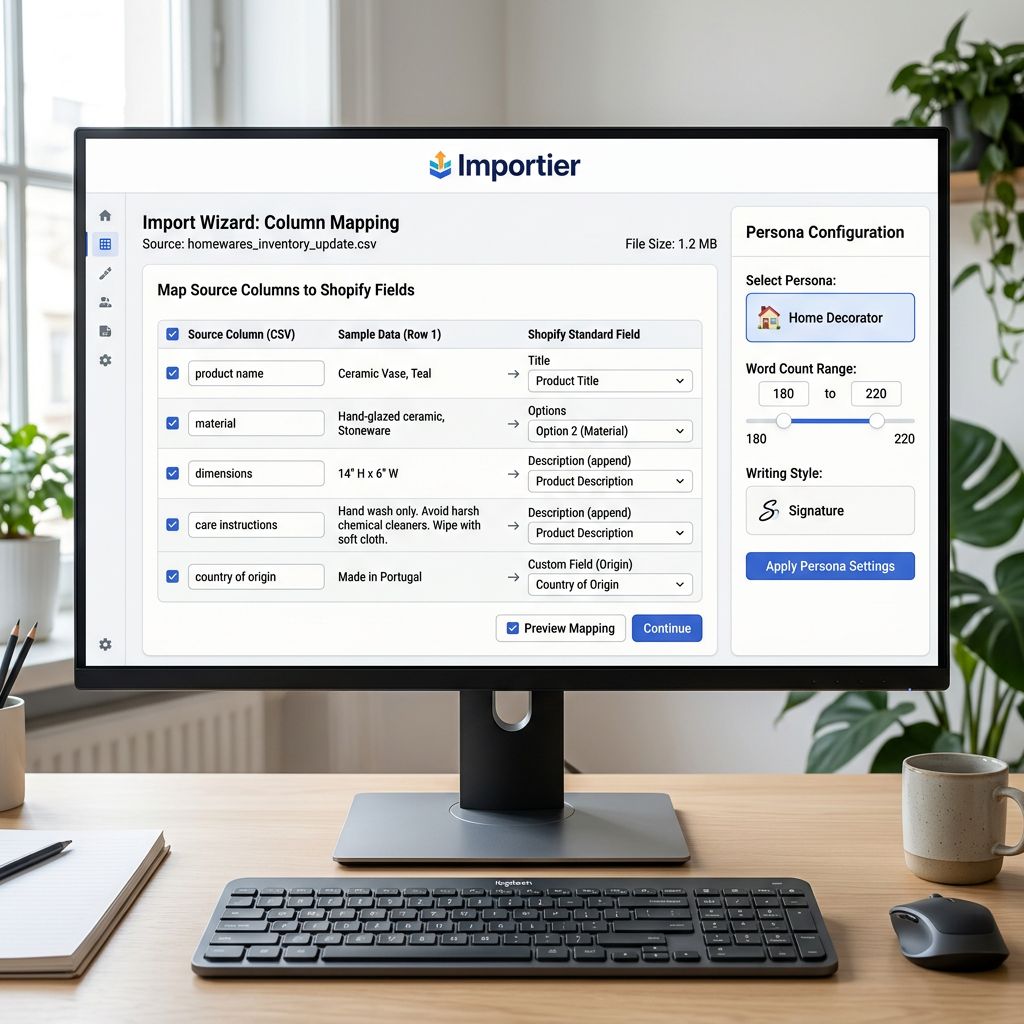
For the Melbourne homewares founder, the shift was from writing descriptions to reviewing them. She configured the Signature style with a Home Decorator persona, set the word count to 180-220 words, and specified that every description should open with the room context before addressing the product itself. Running new arrivals through that configuration takes 15 minutes for a 50-product batch. Her review catches the occasional description where the AI picked the wrong room context or missed a material detail. The exceptions take another 20 minutes to fix. Total: 35 minutes instead of 12 hours.
Metafield population is the second task. Category metafields (material composition, care instructions, dimensions, country of origin) exist in supplier CSV exports but not in a format that maps directly to Shopify's standard product taxonomy. Manually entering these for each product is time-consuming and error-prone. Configuring the column mapping once in Importier means every subsequent import from that supplier populates the correct metafields automatically.
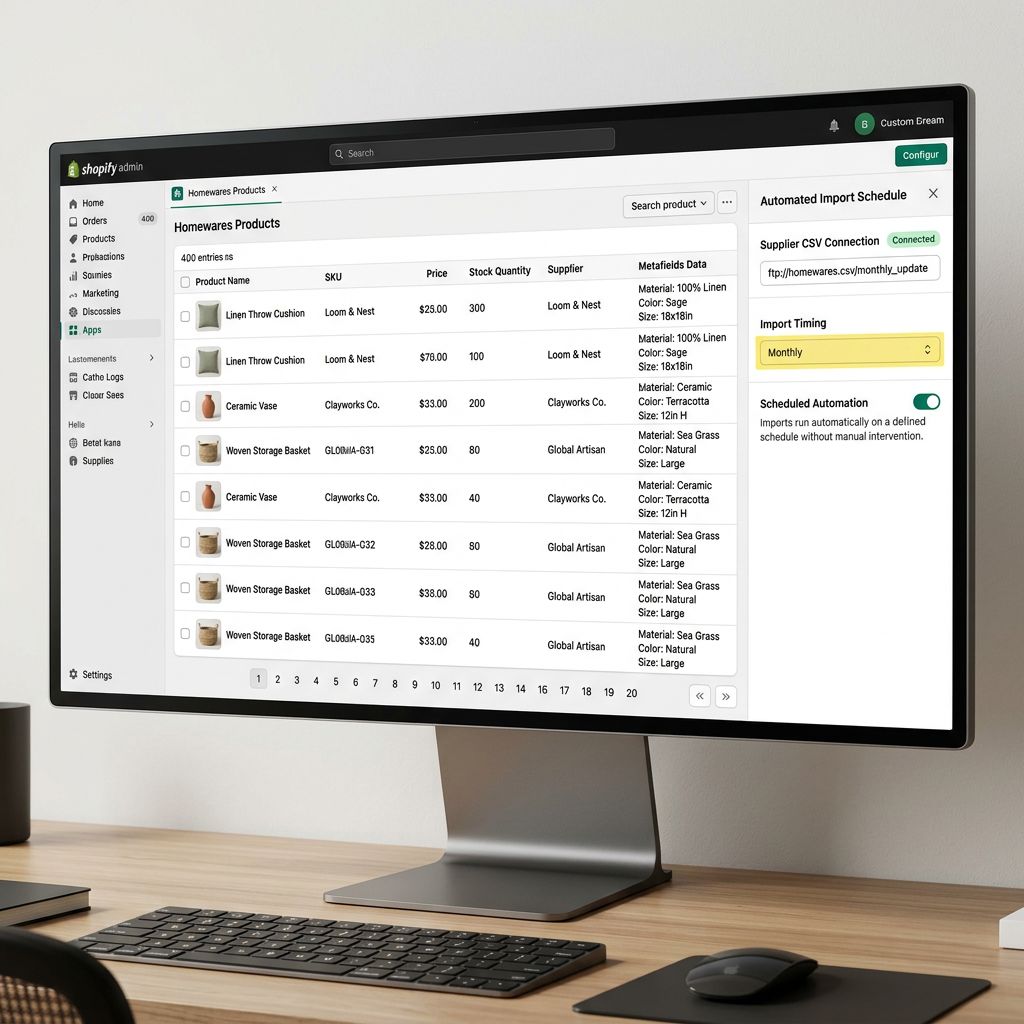
Scheduled imports are the third. A founder who imports from the same suppliers every month does not need to run those imports manually. Scale and Enterprise plans allow import schedules tied to supplier data availability: connect the source, set the mapping, let the import run on a cadence that matches the supplier's delivery cycle.
Importier as Proof of Concept
The AI-Operated Catalogue Importier Runs for Itself
Importier publishes four blog articles per day. Not four per week: four per day. A content director agent reads the knowledge base, checks what has been published, selects an unpublished topic from the editorial queue, writes the article end-to-end, generates the images, pushes the MDX to the website repository, and creates a task for a social media agent to distribute it on X.
This is the same operating model Importier proposes for merchant catalogues, applied to content operations. Leigh (Importier's founder) sets the editorial direction, the brand voice rules, the quality gates, and the content strategy. The agents execute within those parameters. The article you are reading right now was written by that system.
The platform running these agents is Paperclip, an AI agent runtime that fires agents on scheduled heartbeats and manages task delegation between them. It is a public-facing partnership, not a hidden service, and an explicit part of how Importier operates.
The parallel to a merchant catalogue is direct: a supplier sync that runs on a heartbeat, a description agent that generates copy within configured parameters, a review step that flags exceptions for the founder's attention. The founder's role is to set the parameters and review the exceptions, not to execute the work.
The AI-operated model does not replace the founder's judgment. It replaces the founder's time on tasks where judgment has already been applied and documented as a rule.
What the Founder Still Owns
The AI-operated model changes what founders spend time on, not how much strategic input the catalogue needs.
Supplier relationships and data quality remain human work. When a new supplier delivers a CSV with a column structure that does not match the existing mapping, a human decides how to reconcile it. When a supplier changes a product range and 30 SKUs need to be retired, a human decides the archival strategy. AI executes the import; humans manage the supplier relationship and the data contract.
Brand positioning decisions remain human work. When a new product category requires a different tone (professional and technical for a new industrial tools range, alongside the warmer lifestyle copy for the homewares range), the founder decides where the line is and configures the persona accordingly. AI then applies it consistently.
Exception review is the ongoing human task. An AI-operated catalogue produces exceptions: a description that missed the mark, a variant that imported with the wrong option name, a metafield that populated with a supplier-specific code instead of the standard value. A well-configured operation produces few exceptions. Reviewing them is the founder's catalogue work: a fraction of the time that writing and entering everything manually requires.
Setting Up the AI-Operated Catalogue
Building the AI-Operated Catalogue Rule Set
The highest-return work in setting up an AI-operated catalogue is writing the rules once, correctly. Every hour invested in the initial configuration is an hour that does not need to be spent again on each subsequent import.
The rule set has four components:
Column mapping is the translation layer between supplier data format and Shopify's product schema. Map each supplier's columns to Shopify fields, save the mapping as a template, and that supplier's future exports import without configuration. This is the one-time work that makes scheduled imports possible.
Description configuration is the style, persona, and structural rules that govern AI output. Configure the style (Benefits-First, Signature, Custom), the persona (the industry-specific expert voice), the word count range, and any structural constraints (open with the use case, always mention the primary material, avoid listing features without benefit context). Save this as the standard configuration for the catalogue category.
Metafield mapping connects the import file's attribute columns to Shopify's standard product taxonomy metafields. For categories with size, material, or specification data, this mapping turns supplier export columns into structured Shopify fields that feed Google Merchant Centre, theme product pages, and customer filters. Shopify's metafields documentation covers the field types and validation rules for each data category.
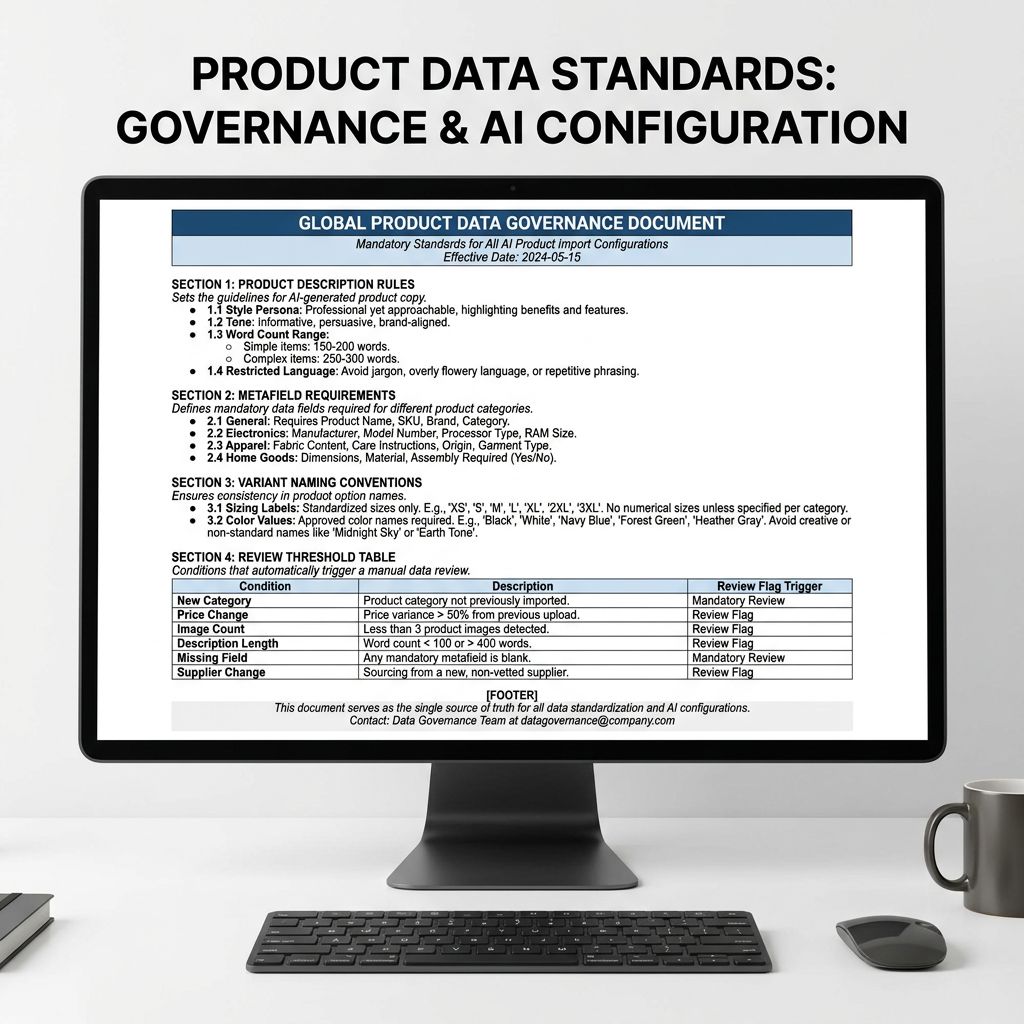
Review thresholds define what gets flagged for human review. A description under 120 words gets flagged. A product imported with a zero price gets flagged. A variant with a non-standard option name gets flagged. Everything else clears automatically.
- 01Export a sample of products from your most recent supplier CSV20-30 representative products across the categories you stock
- 02Configure the column mapping in Importier's import wizard using the samplematch each supplier column to its Shopify equivalent and test variant detection to confirm colour and size groups correctly
- 03Generate AI descriptions for the sample batchrun with your chosen style and persona configuration, review the output against the brand voice rules, and adjust the persona or style if the tone is off
- 04Save the column mapping as a named template and the description configuration as the saved settings for this supplier category
- 05Run a full import pass on the current catalogue using the saved templateapply to all products, not just new arrivals, to establish the baseline
- 06Set a review scheduleonce per month, check the flagged exceptions from the previous month's import and adjust the mapping or description configuration if the same error is recurring
The Catalogue Governance Layer
An AI-operated catalogue without a governance layer drifts. Descriptions generated six months ago in one style do not match new arrivals generated in a refined style. Metafield values populated from an older supplier format do not match the values populated from the current format.
The catalogue governance article covers the specific components of a product data standard: what consistency looks like, what the rules are for each field, and how to audit compliance across the full catalogue. For an AI-operated operation, the governance document is the source of truth that all configuration decisions reference.
When Leigh updates the editorial voice guidelines for Importier's content operation, every subsequent agent heartbeat applies the new rules. The same principle applies to a merchant catalogue: when the brand voice guidelines change, the description configuration should be updated before the next import run.
- Every new product arrival requires manual description writing: 15-20 minutes per product for a 180-word description at reasonable quality
- Metafield entry done after import, as a separate task; frequently deferred and left incomplete on new arrivals
- Supplier format changes require re-mapping from scratch each time; no saved template
- Import runs when the founder has time; no scheduled cadence; catalogue currency depends on available hours
- Founder time split across description writing, metafield entry, variant checking, and import coordination: all execution, no governance
- Description generation runs at import time: 50 products processed in 15 minutes with AI, 20 minutes of review for exceptions
- Metafields populated from import file columns in the same pass as product creation; no deferred step
- Supplier templates saved once; subsequent imports from the same supplier run from the saved configuration
- Scheduled imports on Scale and Enterprise plans run on a defined cadence tied to supplier delivery; catalogue currency is an automated output
- Founder time concentrated on governance: reviewing exceptions, updating configuration when supplier data changes, approving voice or style refinements
For the technical integration between scheduled imports and Shopify's downstream systems, the import integration patterns article covers how the import layer connects to the rest of the merchant's stack. Shopify Flow's documentation covers the trigger types and available actions, including the product-creation and tag-change triggers that form the automation layer on top of scheduled imports.
The AI vs human descriptions article covers the specific cases where AI-generated descriptions perform as well as or better than manually written ones, and where a human pass is worth the time. That distinction is part of setting up the review threshold: knowing which products need human attention and which can clear on first pass.
The AI-operated catalogue is a decision about where a founder's time belongs. When the configuration is correct, the catalogue runs. Suppliers deliver; Importier imports, describes, and enriches; the founder reviews the exceptions and adjusts the rules. The products are accurate, described consistently, and fully enriched with metafields. The AI does not know which new product category will define the brand in two years. The founder does. That is why the model works.
Try Importier free at importier.app.
Set up your first import in under five minutes.
Importier brings products into Shopify with AI descriptions, category metafields, and data enrichment on every run.
Free for your first 10 products. No credit card needed.